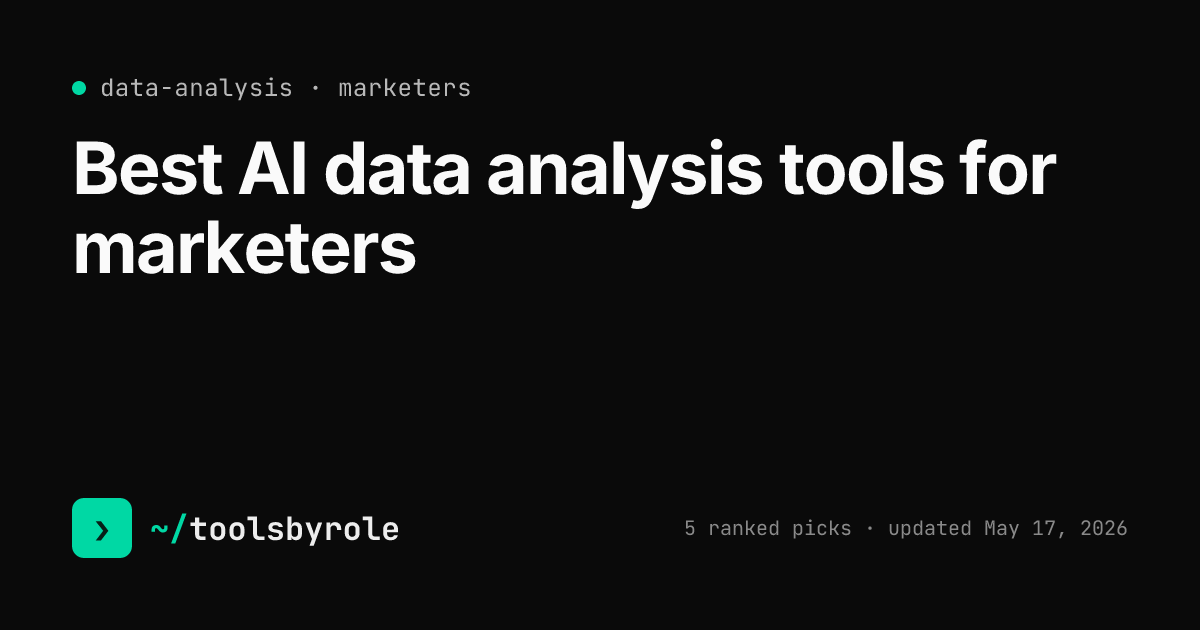
Best AI data analysis tools for project managers
The day-one data analysis stack for project managers:
PMs analyze burndown charts, velocity trends, sentiment-survey results, and ad-hoc CSV exports from Linear or Jira. The four below cover that work without requiring the PM to write SQL or open a notebook.
ChatGPT
★ Editor's pickFree tierOpenAI's flagship. The chatbot most people already pay for, with the deepest ecosystem.
Free tier on GPT-5 mini. Plus is $20/month, Pro is $200/month.
Code Interpreter handles CSV uploads, runs analysis, and generates charts. Best for ad hoc PM data work.
Pros- Custom GPTs lock a style guide so a team doesn't re-paste it every time
- Memory carries context across sessions without a workflow
- Image generation, voice, and web browsing are bundled in
Cons- Long outputs drift off-voice unless you keep correcting
- Memory occasionally pulls in irrelevant past chats
- Pro tier is overkill for most marketing writing
Julius AI
Free tierAI data analyst that writes Python, runs the analysis, and explains the result.
Free tier with 15 messages/month. Basic at $20/month, Pro at $45/month.
Dedicated AI data analyst UI. Better for PMs who do data work daily and want a tool built for it.
Pros- Upload a CSV or Excel file and ask questions in plain English
- Writes and runs Python under the hood, shows the code if you want
- Best in class for non-technical users who need real analysis, not just summary
Cons- Limited to data you upload; no native connectors to warehouses
- Free tier message cap is tight for real exploration
- Code is hidden by default, which can hide errors
Rows
Free tierSpreadsheet with built-in AI functions and live data connectors.
Free tier for personal use. Plus at $8/user/month, Pro at $19/user/month.
Spreadsheet with AI plus connectors to HubSpot, Stripe, and others. Best when data lives in tools rather than files.
Pros- AI functions live inside cells: =AI("summarize", A1) works like SUM
- Native connectors to HubSpot, Stripe, Notion, social platforms
- Familiar spreadsheet interface, no notebook learning curve
Cons- Less powerful for true statistical analysis than Julius or Hex
- Connector library smaller than Zapier-style automation tools
- Pro features required for serious team use
Claude
Free tierAnthropic's chatbot. The 2026 pick for long-form work that has to hold voice.
Free tier with daily limits. Pro at $20/month unlocks Claude Opus and longer sessions.
Long-context analysis when the dataset description and the desired analysis output are both long.
Pros- Longest, most on-voice drafts of any general-purpose chatbot
- Projects feature loads a full brand bible once and pulls from it across every chat that month
- Reads PDFs, decks, and CSVs without setup
Cons- No native image generation
- Smaller third-party ecosystem than ChatGPT
- Free-tier limits kick in fast on long sessions
Frequently asked questions
Best tool for sprint metrics?
Linear or Jira's built-in dashboards for ongoing metrics. ChatGPT or Julius for one-off questions ('why did velocity drop in week 7?').
Can I trust AI-generated charts for stakeholder meetings?
Verify the underlying numbers, then yes. AI is good at chart generation but occasionally mislabels axes or chooses wrong chart types.
How do I analyze sentiment from team surveys?
ChatGPT or Claude with the survey text. Both will flag themes, but verify against the raw responses; AI smooths out outliers that matter.
Excel and Sheets AI features vs dedicated tools?
Built-in features are improving but still behind dedicated tools. Use Excel/Sheets for ongoing analysis, ChatGPT or Julius for explorations.